
Bacterially Derived Therapeutic Proteins: Why Early Process Strategy Matters
By Kent Davis, and John Neville, PhD
List Labs
July 2026
Bacterial expression systems remain one of the most important platforms for producing therapeutic proteins, bacterial-derived proteins, toxins, toxoids, enzymes, vaccine components, and other biologically active molecules. Their speed, scalability, well-understood genetics, and long history of use make them attractive for both early discovery and clinical development.
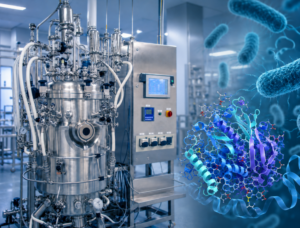
But bacterial expression is not simple.
For sponsors developing bacterially derived therapeutic proteins, success depends on more than achieving expression. These programs require early attention to purification strategy, endotoxin control, impurity clearance, protein activity, analytical development, and phase-appropriate CMC planning. The decisions made in early development can determine whether a program moves smoothly toward IND-enabling studies and clinical supply or encounters costly rework later.
Bacterial systems are powerful, but they are also unforgiving. Their value is realized when expression, purification, characterization, and manufacturing strategy are developed together from the beginning.
Why Bacterial Expression Systems Remain Important
Bacteria are widely used in biopharmaceutical development because they can grow rapidly, reach high cell densities, and support efficient production of many recombinant proteins and bacterial-derived products. Compared with more complex expression systems, bacterial platforms may offer advantages in speed, cost, scalability, and process familiarity.
These strengths make bacterial expression systems especially useful for:
- Recombinant therapeutic proteins
- Bacterial toxins and toxoids
- Vaccine antigens and components
- Enzymes and biologically active proteins
- Research-grade and GMP-grade bacterial-derived products
- Early-stage development programs requiring rapid iteration
However, the same biological features that make bacterial systems productive can also create development challenges. Bacterial host cells generate process-related impurities, including host-cell proteins, host-cell DNA, endotoxin, media components, and product-related variants. In some cases, the protein of interest may require careful control of folding, solubility, aggregation, activity, or stability.
For that reason, bacterial expression should not be viewed simply as a fast production method. It should be treated as a complete development platform with specific CMC and manufacturing requirements.
Expression Is Only the First Step
A common early mistake in bacterial protein development is placing too much emphasis on expression level alone. High expression is valuable, but it does not guarantee a developable product.
A protein that expresses well may still be difficult to purify, unstable during processing, prone to aggregation, or challenging to characterize. It may also carry a significant impurity burden that becomes harder to control as the process scales.
Key development questions include:
- Is the expressed protein soluble, active, and properly folded?
- Can the product be separated from host-cell impurities?
- Can endotoxin be reduced to an acceptable level?
- Does the purification process preserve yield and biological activity?
- Are product-related variants understood and controlled?
- Can the process be scaled without changing product quality?
- Are analytical methods appropriate for the product’s intended use?
These questions need to be addressed early because they shape the entire development path. A strong bacterial protein program is not built around expression alone. It is built around the relationship between expression, recovery, purification, activity, stability, and release testing.
The Central Challenge: Purity Without Losing Function
For bacterially derived therapeutic proteins, purification strategy is often one of the most important determinants of program success. The process must remove impurities while preserving the quality and biological activity of the target protein. This balance can be difficult. A purification process that is aggressive enough to reduce impurities may also reduce yield, alter protein structure, or affect potency. A process that preserves activity may not
provide enough impurity clearance for later clinical expectations.
Common challenges include:
- High levels of process-related impurities
- Endotoxin burden from Gram-negative bacterial systems
- Residual host-cell proteins and host-cell DNA
- Product aggregation or fragmentation
- Protein variants and charge heterogeneity
- Loss of activity during purification or formulation
- Stability risks during storage and handling
This is why downstream process development should begin early. Purification is not simply a cleanup step after expression. It is part of the product strategy.
For bacterial-derived products, the right purification approach must account for the molecule, the host system, the intended clinical use, the phase of development, and the regulatory expectations that will apply as the program advances.
Endotoxin Control Must Be Designed Into the Process
Endotoxin control is one of the defining challenges for many bacterially derived protein programs, particularly those using Gram-negative bacterial expression systems. Endotoxin is not just another impurity. It is biologically active, tightly regulated, and often difficult to remove once it is associated with the product or process stream.
Effective endotoxin management requires more than final product testing. It should be addressed through process design, raw material controls, purification strategy, analytical methods, and environmental controls.
Important considerations include:
- Selection and control of the bacterial host system
- Understanding where endotoxin enters or concentrates in the process
- Use of purification steps capable of endotoxin reduction
- Monitoring endotoxin throughout development, not only at release
- Avoiding process conditions that increase endotoxin carryover
- Ensuring methods are appropriate for the product matrix
Endotoxin control becomes increasingly important as a program moves toward clinical use. If it is not considered early, sponsors may discover late in development that a process capable of producing protein is not capable of producing clinical-grade material.
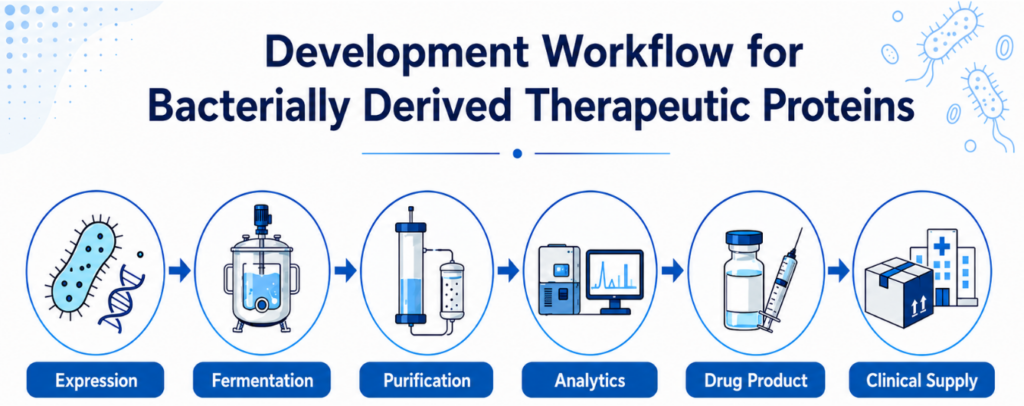
Figure 1. Development workflow for bacterially derived therapeutic proteins. Although shown sequentially, several activities—including analytics, purification planning, endotoxin control, and formulation strategy—often progress in parallel as process understanding evolves.
Preclinical Development: Build With the End in Mind
The preclinical stage is where many of the most important process decisions are made. At this stage, the goal is not only to produce material for studies. It is to determine whether the expression and purification strategy can support continued development.
Early development should focus on feasibility, scalability, and product understanding.
Important preclinical priorities include:
- Selecting and controlling the expression system
- Developing initial fermentation conditions
- Establishing a practical downstream purification sequence
- Assessing impurity and endotoxin clearance feasibility
- Understanding solubility, folding, activity, and stability
- Creating fit-for-purpose analytical methods for identity, purity, potency, and impurities
- Identifying process risks before GMP manufacturing
This stage should also help sponsors understand which process parameters are most likely to affect product quality. For bacterially derived proteins, changes in fermentation, harvest timing, lysis conditions, chromatography, filtration, or formulation can have meaningful effects on the final product.
Preclinical development is therefore the right time to ask whether the process can mature. A process that works at small scale may not automatically support GMP manufacturing, clinical supply, or later-stage comparability expectations.
Phase I: Demonstrating Control and Patient Safety
By Phase I, expectations shift. The process does not need to be fully optimized, but it does need to be defined, controlled, documented, and appropriate for producing clinical material.
For bacterially derived therapeutic proteins, Phase I readiness often depends on whether the sponsor can demonstrate sufficient control over the expression system, purification process, impurity profile, product characterization, and stability.
Key Phase I considerations include:
- Well-characterized cell banks
- Defined fermentation and purification steps
- Documented process controls
- Qualified or phase-appropriate analytical methods
- Defined impurity profiles and acceptance criteria
- Endotoxin testing and control strategy
- Stability data to support clinical use
- Drug product formulation and, where needed, aseptic fill/finish readiness
At this stage, analytical methods become especially important. Sponsors need methods that can support identity, purity, potency, safety, and release testing. These methods may continue to evolve, but they must be scientifically appropriate for the product and development phase.
Phase I is also where early shortcuts can become visible. If endotoxin clearance, impurity control, or protein stability were not addressed during preclinical development, the program may face delays before clinical material can be released.
Phase II: Robustness, Comparability, and Supply Readiness
As programs move into Phase II, the emphasis expands from producing clinical material to producing it consistently. Sponsors may need larger batch sizes, more frequent manufacturing campaigns, tighter specifications, and more mature analytical methods. At this stage, development teams should focus on process robustness and supply reliability.
Important Phase II priorities include:
- Expanding process understanding and operating ranges
- Increasing batch scale or campaign frequency
- Strengthening impurity and endotoxin control
- Improving analytical sensitivity and method performance
- Tightening product specifications where appropriate
- Managing process changes through comparability assessments
- Supporting stability programs for broader clinical use
- Preparing for multi-site or longer-duration clinical supply needs
Phase II is often where early process decisions are tested. A purification strategy that was acceptable for small early batches may not support higher demand. A formulation that worked for short-term studies may not provide the stability needed for broader clinical use. An analytical package that was sufficient for Phase I may need to become more quantitative, sensitive, and specific.
The lesson is straightforward: bacterial protein development benefits from phase-appropriate planning, but phase-appropriate does not mean short-sighted. Early decisions should leave room for the process to mature.
Lessons for Sponsors Developing Bacterially Derived Proteins
Bacterial expression systems can support highly effective development programs when their challenges are anticipated early. The strongest programs tend to share several characteristics.
First, they connect expression strategy with purification strategy from the beginning. Expression level matters, but a protein must also be recoverable, active, stable, and purifiable.
Second, they treat endotoxin and impurity control as process-design issues, not final testing problems. Testing can confirm control, but it cannot compensate for a poorly designed process.
Third, they build analytical methods that mature with the program. Early methods may be fit for purpose, but they should create a foundation for later release testing, comparability, stability, and regulatory documentation.
Fourth, they consider drug substance and drug product needs together. A purified protein still needs to remain stable, active, and suitable for clinical administration. Formulation, storage, and fill/finish strategy should not be disconnected from upstream and downstream development.
Finally, they recognize that bacterial protein programs require specialized expertise. Bacterial fermentation, purification, endotoxin control, potency testing, lyophilization, and aseptic readiness all require practical experience with microbial systems and bacterial-derived products.
Where List Labs Fits
List Labs has more than 45 years of experience working with bacterial-derived products, including bacterial fermentation, purification, lyophilization, cGMP manufacturing, and development of products where endotoxin control, potency, purity, and process consistency are critical.
For sponsors developing recombinant proteins, toxins, toxoids, vaccine components, or other bacterially derived therapeutic proteins, this type of microbial experience can support the transition from early development to clinical supply. More broadly, it reflects one of the key lessons in bacterial protein development: manufacturing expertise should not be treated as a late-stage service. It should be part of the development strategy from the beginning.







 Find a distributor near you
Leave a Reply